
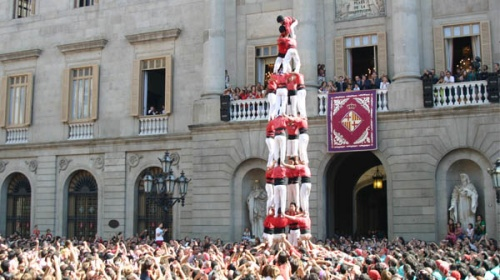
At street level, you see the tower. During a Catalan festival, a colla—a club of a few hundred people—builds a human tower until a child climbs to the top and raises a hand. That is the castell. It is the part everyone films.
What you do not see, unless you are looking down from above, is the pinya: the wide, dense base of people locking arms at the bottom. There are far more people in the base than in the tower. The pinya is both foundation and safety net. It carries the weight of the tower and catches people if it falls. It is not the glamorous part; it is the part that makes the rest possible.
You can’t go up if you don’t have a base.
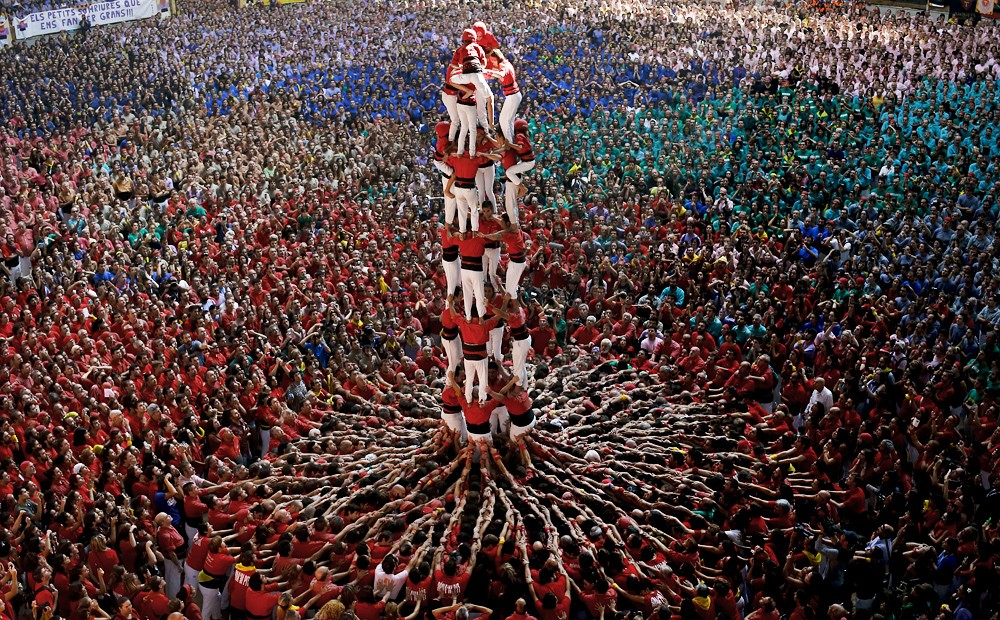
Credit: South China Morning Post
Organizations work the same way. We tend to focus on what is visible: the new product, the launch, the transformation, the AI tool, the faster delivery cycle. Underneath all of that is a base made up of processes, practices, decision-making, roles, hand-offs, tools, and relationships. That base determines how much speed and complexity the organization can actually carry.
We saw this in a recent piece of work involving an urgent production defect. A public-facing service had failed, blocking a group of users from meeting an obligation. Everyone agreed the issue needed to be fixed. But the request arrived just after a prioritization window had closed, so it had to wait for the next funding decision.
The client escalated. It sat. They escalated again. By the time funding was approved, nearly seven working weeks had passed and the issue had reached the executive level. Then it took another two weeks to assign a team before the fix went into flight.
A gemba walk showed that the problem was not simply one slow approval or one bad decision. The request had fallen through the seams of the system. A new prioritization process had been designed for normal portfolio decisions, but there was no effective path for an emergency to move from identification to action. Nobody had intended that outcome, but the system produced it anyway.
The question that portfolio leaders need to ask is: “Is this how we want the system to behave?”
This matters even more as organizations adopt AI. AI can dramatically accelerate parts of the system. It can help people produce code, analysis, designs, documents, and plans much faster. But making one part of a system faster does not make the whole system faster.
As Eliyahu Goldratt argued in The Goal, every system has constraints. Relieve one constraint and another becomes visible. If AI increases the volume and speed of work entering the system, pressure can move upstream and/or downstream. The bottleneck may become prioritization, funding, review, governance, deployment, adoption, or a decision that only one overloaded person can make. The organization may simply create more work than anyone has capacity to own.
AI does not remove the organization’s weaknesses. It exposes them.
So the useful question is not “How much faster can we produce?” It is “Can the rest of the system carry what we are producing?”
The castells offer one more useful lesson. A tower does not count as a success simply because it reaches the top. It must also come down cleanly, level by level, without collapsing. The colla rehearses the descent as seriously as the climb.
Organizations are much better at climbing. We celebrate building and launching, but we are less disciplined about retiring systems, decommissioning infrastructure, removing old controls, or shutting down the process that the new one was supposed to replace. So the base gets heavier. Old systems remain. Old processes remain. New ones are layered on top.
And if AI helps us create more, faster, we can accumulate that weight faster too. That is why the conversation about AI cannot only be about acceleration. It also has to be about whether the system can carry the acceleration.
Before you build higher, look down. Walk the work and find where it waits. Look at the approvals, hand-offs, ownership gaps, and old systems accumulating underneath it. Ask what is carrying load and what is simply adding weight. And plan the descent as deliberately as the climb.
Because speed is only useful if the base can carry it.