Map have always helped people make sense of a landscape: what’s near, what’s far, and how things connect. We bring the same instinct to agile planning.
When we work with scrum teams and leaders, one of the most powerful things we can do is build a shared visual of where we are and where we’re going. Whether we’re using a whiteboard or a digital tool like Miro, Mural or FigJam, this means everyone is looking at the same picture. Conversations get sharper and decisions get easier.
Here’s the approach we use to connect the big picture to the work happening right now.
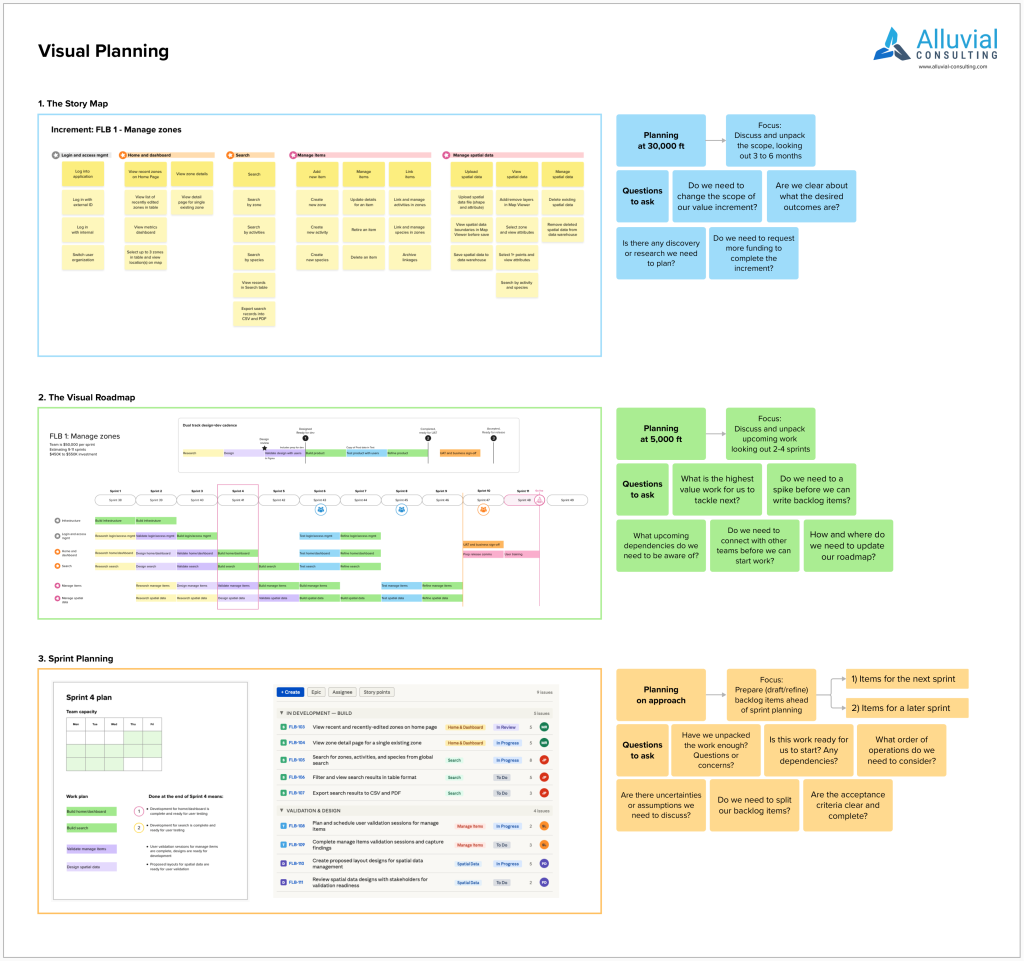
Planning at 30,000 ft: The Story Map We start by capturing the scope of a ‘value increment’: what will users actually be able to do when we deliver this work? A story map gives us a user-centred view of the whole before we’ve committed to anything specific.
Planning at 5,000 ft: The Visual Roadmap Then we zoom in to a timescale. We put epics or features down the side and sprints across the top. Drawing on the dual-track model, we lay out design and development work side-by-side so the team can see the full picture and plan refinement with their eyes open.
Planning on approach: Sprint Planning In sprint planning, we get concrete: what are we starting, what are we finishing, and what needs to be ready for the next sprint? We refer to the roadmap, look at where we are in the process, and define done for each piece of work. Then we move into Jira and GitHub with a clear view of what tickets we need to assemble and why.
This is the kind of facilitated planning we love doing with teams. If you’re curious about how it could work in your context, reach out*—*we’d be glad to talk.